
Sara Davidson
|August, 20, 2025
This is Part 3 of my visit to Cuba ten years ago. To read previous parts, click here.
After five days in Havana, we take a chartered bus on the rough, two-lane road—the only road—that runs the length of Cuba. A billboard proclaims, “Siempre adelante”—always forward—which seems like cognitive dissonance. A horse-drawn wagon is pulling a flatbed on which a dozen working men are standing up, jammed together, and in the fields, men are cutting cane with machetes. Along the sides of the road they’ve planted a living fence—a continuous row of sharp-thorned cactus—to prevent livestock from crossing.
In the countryside, the only cars we see are beat-up junkers, not the slick, refurbished cars of Havana. But the landscape is bucolic: fields of corn, hollyhocks and sunflowers, roosters crowing, cows mooing, mountains rising on one side and on the other, the sea.
When we reach Santiago de Cuba, our hotel offers dial-up Internet on an antique computer for $8 an hour, but I avert my eyes. I don’t want to go near it. Contrary to what I’d expected, being unplugged has been a relief. I hadn’t realized until I was forced to withdraw from it how much the Internet keeps the brain and nervous system on edge, alert to the dinging, ringing, and tapping in the never-ending cycle of receiving and responding. Just a few days after disconnecting, I could feel my body letting down. It was a level of relaxation I hadn’t experienced since the 90’s, before email, before the 24-hour glut of information.
Santiago de Cuba is the place where, on July 26, 1953, Fidel and his younger brother, Raul, staged their first armed attack, on the second largest military barracks in the country, Moncada. Fidel had 120 rebels in a caravan of cars, but the cars got separated and the one carrying the heavy weapons got lost. The men who did reach the barracks started firing too soon and were outnumbered ten to one. They lost the battle and 61 were killed, but the revolution was on.
As we tour the barracks, now a museum, I stop before a wall on which is written: “Every revolution has 3 phases: conspiracy, insurrection, and ultimately, the phase where it truly begins. Here was born the liberty of Cuba.”
Below are large black and white photos of the faces of the 61 killed. They’re so young—the average age is 19. Each has a unique expression, with singular eyes and set of mouth. I stand looking at each face, sounding out the young man’s name. I can imagine what they felt: the rightness of their cause; the passion to transform an illiterate, poor country into a society where every person would learn to read, have free health care, education, housing and a job.
It was the call to action that many of us felt in the 60’s and early 70’s. I had friends at Berkeley who went on freedom rides and voter registration drives in the south, risking and, in a few cases, losing their lives, inspiring thousands of others to commit themselves to the Movement. It was this passion, I suspect, that spurred Cuban students, after Fidel triumphed in Havana, to take a year off school to go out in the countryside and teach campesinos to read. And it came to me: if I’d been a Cuban in my teens or 20’s at the time of the revolution, I would have been with Fidel.
I’m awakened the next morning by the sound of drums. Walking out on my balcony, I see a large group of musicians gathering in the square, drumming, singing, and I feel my body entraining with the music. As I walk about the streets, I’m holding myself taller, aware of my hips, the length of my steps, the loosening of my shoulders and neck. And I’m actually beginning to enjoy the way women dress. It’s not subtle but vibrant and fanciful, and it’s inclusive. A man I meet at a music club says, “Our first principle is: Every woman is beautiful.”
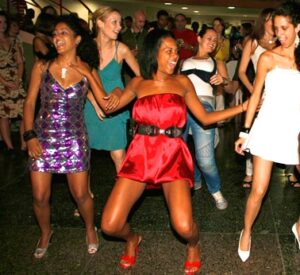
On several nights we go to dance performances and each is radically different. The Afro-Cuban dancers are fierce and raw, acting out stories of the gods struggling with each other. In contrast, the Tumba Francesa, the first native dance developed in Cuba in the 1800’s, is mannered and formal. During the slave revolts in Haiti that began in 1791, precipitating the revolution there, French plantation owners fled to Cuba with their slaves. In their new encampments, the slaves, after working in the fields all day, often gathered to make music and imitate the French court dances they’d seen their owners doing—minuets and quadrilles. At a club in Santiago, we watch pairs of dancers sashay out in costumes made of cheap fabric but styled like those of the slave owners, with ruffles, sashes, and petticoats. The dance looks like a mix of African, 18th century French, and American square dancing, to the beat of giant drums.
After the last number, the lead male dancer reaches for my hand to lead me to the floor. I hesitate; I’ve been in remission from vertigo since arriving in Cuba, and nervous that dancing might bring it back. But I can’t help myself. As the drums grow louder, the Cuban man moves me about with such assurance that I’m dancing better than I thought I could. It’s like playing tennis with a strong player—you hit better—and with a great dancer, you can’t make a mistake.
Cuban men learn to dance before they talk, I’m told, by a man who’s an art historian. “We learn in the crib. It’s genetic.” I observe this later in the mountain town of Yateras, where a two-year-old boy plays maracas in his grandfather’s band, shifting his weight from foot to foot in perfect rhythm.
Of the numerous men I’ve dated in my life, there was only one who liked to dance. Men don’t understand that they don’t have to be great; if they can lead and keep the beat, any woman in the room will be their partner. Knowing this, I tried to encourage my son to dance but he never really took to it. So to be in a country where men are enthusiastic to dance with me…. well, it’s the closest I’ve come in quite a while to bliss.
On another night, we’re invited to the launch of a book that our leader, Trish, helped publish, at the Cuban Union of Intellectual and Creative Artists. As the author speaks, I take notes on my iPad. After the talk, a slim Cuban man, about 50, asks what I’m writing. He says he’s a journalist for a local paper, and his name is Charles Dickens Garcia-Lopez. I ask how he got that name. “My father is a writer and loves Dickens,” he says. We have a spirited talk about Dickens’ novels, and journalism and publishing in Cuba and the U.S., and then I see our group preparing to leave. Charles Dickens asks where I’m staying, and if I’d like to continue talking? I find Trish and ask if he can come back to the hotel on the bus with us, expecting her to say, okay. But she looks at me a long moment. “I’m not sure.”
What do you mean?
“You don’t know who you’re talking to in Cuba. He wasn’t on the guest list of people we invited.”
Chastened, I say goodbye to Charles Dickens and we exchange contact information, although I don’t imagine we’ll ever speak again.
That night, I’m jarred awake at 4 a.m. by a loud ringing sound. Disoriented, I try to figure where it’s coming from. As the ringing continues, I turn on a light and trace the sound to an old-fashioned rotary phone in a corner. I haven’t used a phone since I’ve been in Cuba and hadn’t noticed there was one in the room, and then it stops ringing. My mind races. You don’t know who you’re talking to in Cuba. That afternoon, we’d met with a district official and I’d asked a question: Is Cuba’s government changing? Irritated, he snapped, “There are things that will never change. The political system—socialism—will not change.” He pointed a finger at me. “The government can’t provide everything, especially during a financial crisis.” Later he’d asked Trish why I was taking notes. She took me aside and suggested I be more discreet.
I lie awake worrying, am I being watched? Was Charles Dickens a government plant? I have a friend in New York, a writer, who went to Cuba after the revolution to teach, and was arrested, accused of being a spy, and imprisoned for 18 months. If I should be carted off to jail, there’s no one, absolutely no one I could call for help. The only way I can soothe myself to fall asleep again is with the thought that if that happened… I’d have a damned good story.
The last place we visit is Baracoa, a small town with old world charm, at the very eastern tip of the island. It’s where Columbus landed, and at Our Lady of the Assumption church, they have the cross he allegedly planted in the sand. Liliana tells us that the first land deed Castro signed over to a campesino was in Baracoa. “He started giving land back to the people at the same place where the Spanish colonizers started taking it.”
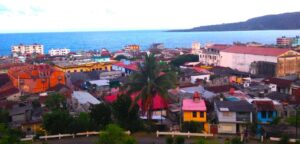
Our hotel, the Castillo, feels like paradise, especially after some of the ones we’ve stayed at that had threadbare sheets, scratchy towels, lights that don’t work and only a trickle of water dripping from the shower. The Castillo sits on the highest hill in town, has a sparkling clean swimming pool, and rooms that look out on water in two directions—the Straits of Florida and the Atlantic.
I wander through the streets of pastel houses with decorative iron grillwork. Horses are pulling carriages and people are eating pizza they buy for a few pesos from a window in someone’s home. It’s hotter and more humid than anywhere else we’ve been, and in no time, sweat pours down my face and chest. I climb back up the hill to our hotel to take one of the four showers I’ll have today. I didn’t bring any tank tops or shorts, since I’ve stopped wearing such garments, so I put on a black sports bra and tie a thin sarong from Hawaii around my chest as a dress. I’m showing as much skin now as Cuban women. Can’t beat ‘em, join ‘em.
My one disappointment on this trip has been that no one in our group—whose median age is 70—wants to go out at night to hear music or dance. So I’ve taken to going alone. I show up at matinees around 5 p.m., take a seat and in minutes, someone, usually younger than my son, escorts me to the dance floor. Everyone dances—from those so old they can barely make subtle movements to six-year-old girls who know how to shake it.
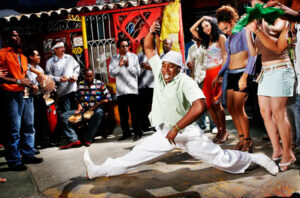
I feel sultry, juicy, but wonder if I look like my mother did when she took up square dancing in her 60’s and flirted with her partners.
On our last day, we drive back to Holguin, where we’ll catch a charter flight to Miami. I know that as soon as the wheels touch down, emails will start flooding into my phone and I’m dreading it. I don’t want to be ensnared again, after being in a country where everybody’s unloosed.
I think back to the last matinee I attended in Baracoa. A young man who was a head shorter than me was the first to ask me to dance, and when the song ended, he said his friend wanted to meet me also. The friend had Rasta dreadlocks and was the best dancer yet. As he whisked me around the floor, my sarong slipped down to my waist, leaving me in the sports bra with a bare midriff, but no one seemed to pay any mind. I felt unfettered and alive. I’d arrived in Cuba feeling my currency had been spent, and was leaving with the knowledge that I still have untapped reserves. As the music grew louder and faster and the matinee drew to a close, I confess: Reader, I led everyone on the floor in the limbo.
I appreciate and respond to your comments.
xxxx
Yes, even better re-reading