
Sara Davidson
|June, 20, 2025
I’ve just finished reading the first book I wrote, almost fifty years ago, Loose Change, Three Women of the Sixties. I hadn’t looked at it in decades and was nervous I’d find it embarrassing. And dated.
To my relief, I was surprised at how smoothly it reads. I especially enjoyed the return, in its pages, to my childhood years in L.A., which was then considered a remote part of the country, “the West.” In the L.A. of my childhood, I knew most of my neighbors. All the kids played together outside on Orange Street, on which there was little traffic.
Once a week, a man named “Mr. Stern” would come around with his truck loaded with fresh fruits and vegetables. My mother left our back door unlocked, in case she wasn’t home when Mr. Stern arrived. He would walk in the back door, go to the kitchen and open the refrigerator, as my mother had instructed him to do, and see what she was missing from her usual order. He’d leave new fruit in the bowl and new vegetables in the fridge and my mother would pay him the next time she saw him.
In my teenage years, I spent almost every weekend at the beach, where each high school in the city had its territory. The boys would show off, riding waves, and the girls would sit on the sand, protecting their hairdos, in their newest two-piece bathing suits, holding silver sun reflectors under the chin to make their faces tan fast. (We paid for that, of course, decades later) The entire time I was growing up, I did not own a coat. Just sweaters and an occasional jacket for what was considered “winter.”
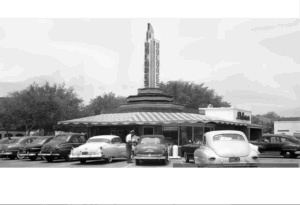
I remember the drive-in restaurant, Dolores, which our family would go to as a treat, (and was later a teen hangout known as “D.L.’s”) The waiter would fasten a tray to the window on the driver’s side and bring out our double-decker burgers and Susie Q fries. I ask myself, now, what was the point of eating in the car?
 On Sundays while we were young, our father took my sister and me to Beverly Ponyland, at the corner of Beverly Blvd. and La Cienega, which is now the site of an eight-story shopping mall. But back then, on that corner was a small amusement park and a string of ponies for kids to ride. The wrangler, whom we believed was a real cowboy, because of his hat, would hoist us up on the saddle, then lead the horse to one of three concentric rings. In the innermost ring, the horses had been trained to walk slowly, carrying an ecstatic (or screaming) two-year-old. The second ring was for the horse to walk slightly faster, and the outside ring—our delight—was for trotting. The wrangler would give the horse a thump on the rear and off he’d trot, with us waving and shouting, “Look, Daddy!”
As soon as we got our learner’s permit to drive, at fifteen, we would cruise in cars on Hollywood Blvd, preferably in a convertible, flirting with strange guys in their convertibles. I remember, though, not feeling happy about my body. I was too tall; in one year of junior high, I grew from 5’2” to 5’8.” I was taken to our family doctor, Dr. Furer. His patients were mostly Jewish but no one seemed to think his name was unfortunate. He gave me weekly hormone shots supposed to close my “growth centers,” but I continued growing to be 5’10.”
I did not cover those specific memories in Loose Change, which begins when I and my friend Susie were “rushing” to be accepted by a sorority for Jewish girls at U.C. Berkeley. The Gentile sororities would not consider us, and we did not question that, although subsequent generations did. Now the sororities are required to accept at least several pledges of different faiths and races.
My close friends and I only stayed in the sorority for two years. Then we went to Europe—part of the great wave of students going to study or travel there—and when we returned, feeling more sophisticated, we rented an apartment off campus.
Recently, in the nation-wide demonstrations against President Trump, there did not seem to be many young people protesting. The majority seemed in their late thirties and older. Perhaps this was because it was summer and colleges were on recess, but still… I wondered why younger people were not involved.
The generation of kids who came of age in the ‘60’s and early ‘70’s were not just involved; we led the demonstrations. At Berkeley, in 1964, my friends and I participated in the march for civil rights at the Sheraton Palace in San Francisco, which had an unspoken policy of not hiring Negroes. The demonstration was a must for everyone we knew. We walked round and round the hotel, carrying signs and chanting for hours, and then one of the protest leaders, a young black woman, Tracy Sims, announced over a megaphone: “We are going inside now—to stop the hotel from doing business as usual.” She said we were going to sit down in the lobby, thousands of us. She cried out, “Are you willing to get arrested for what you believe in?” People shouted, “Yes!” but my friends and I looked at each other and mouthed, “No.” My father had warned me, “Don’t sign anything, and don’t get arrested, it could ruin your future.” We began walking back to our car, watching as police hustled hundreds of young people into paddy wagons.
We were proud, though, that we had been there. We were showing that no longer would young people be “apathetic.” That was the 1950’s. We were the Sixties generation. We were…Committed.
NOTE – When I speak of the Sixties Generation, it’s about the group who identified with progressive ideas and actions. It does not include people like Donald Trump and George W. Bush who were born then but swam in an opposite stream. As we asked then, “Which side are you on?”
While I was dropping my granddaughter off at Sproul Hall yesterday I thought of your book Loose Changes
I’d be interested to know how your granddaughter’s experience comepares to ours. Warm regards.
Sarah, I can’t tell you how important “Loose Change” was to me. I attended Cal in 1970 and would go on to get a doctorate in clinical psychology. I studied the Berkeley students who had been arrested in the FSM. The research was quantitative in keeping with the demands of my field, but books like yours provided much of the qualitative backdrop for coming of age at that moment. In fact, while on clinical internship, I studied with Dan Levinson at Yale who was developing his model of adult development. I used your characters to apply his theory for its relevance to women, since his work had been exclusively with men. I’m glad to know the book holds up. You’re inspiring me to reread. It definitely would be revisiting the characters and ourselves. Thanks for your important contribution!
And thank you, Alberta, for your thought-provoking comments. I’d be interested to see how the characters in Loose Change would fit into Levinson’s model. Warm wishes, Sara
And thanks for your kind words. Warm wishes to you.
Hi Sara, I just very recently re-read Loose Change. I read it again every few years (as I have since I first read it back in the mid-70s). My teenage years were in the ’70s, but I have a few similar memories of growing up in LA. The pony rides at Beverly and La Cienega, for sure, and we had the Helms Bakery van come to our neighbor (grew up at Robertson and Cadillac). My best friend’s mother was much younger than my mother and went to demonstrations and had political posters in their house.
However, as the years have gone by my perspective has changed a bit. Some of the activities undertaken by extremists these days makes me think about what was happening in the ’60s and really wondering if it was as positive as I thought. When I am appalled by some of the rhetoric on the right voiced under the banner of free speech, I do think back to similar situations in the ’60s. Have you thought about any parallels to the right-wing radicalism of now and the left radicalism of the ’60s? If so, I would love to hear your thoughts on that. I’ve only had fleeting thoughts on this and haven’t dived deeply into comparisons but thought I would ask since during your journalism career, you reported on cultural and political movements. I have not grown more conservative as I have aged, but I do look at things with more of a historical lens due to my life experiences.
Thanks, Kat, for your comments. I dont see any parallels between rightwing radicalism today and left radicalism of the 60s. I thnk theyre based on very different values, and the two groups wouldn’t find much in common. But I appreciated hearing your thoughts. Warn wishes, Sara
Thanks, Kat, for your intriguing thoughts. I don’t see parallels between Sixties leftist protest and right wing radicalism today, but I’d love to hear how you do. I don’t imagine any former leftists supporting Donald Trump.
It was fun reading about my childhood. I loved “Loose Change.”
Hi Sara, Boy did you bring back memories of growing up in LA and Berkeley. So pathetic now.
Donna, great to hear from you. Warm wishes, Sara
I agree, unfortunately the protesters these days are predominantly older. I work as a substitute teacher at a local high school and, while I can’t talk politics, I strongly encourage the students to pay attention to the news because there are things happening that are shaping the country and the world they will inherit. I also suggest trustworthy, objective news sources such as morning news email summaries from AP or PBS. In our youth, so many of us participated in the powerful protests for civil right and against the Vietnam War. Now we can only show up at the current anti-Trump protests and hope to lead by example and pry the younger people away from their phones.
Well said, Debbie. I agree. Warm wishes, Sara
Hi Sara. Your beautiful writing brought back many memories as I too was born and raised in Los Angeles. My parents took me for pony rides where the Beverly Center now stands. In High School, my friends and I were brave enough to drive from Beverly Hills High School to Dolores’s for lunch. It was a special time even though the LAPD broke up an antiwar demonstration in front of the Century Plaza Hotel with tear gas. “Thanks for the memories.”
And thank you, Tom for your kind words. It means a lot to hear from you.
I read Loose Change when I was in college (I still have my copy), and then watched it on television. I love all of your writing, and I keep meaning to get a copy of your book on Joan Didion. What’s keeping me? I’m not particularly tech savvy (lol). I have copies of several of your old articles and reread them sometimes. Your voice, like Joan Didion’s, never gets old for me.
Since you brought it up, I am “on the other side “.
Thanks for your kind words. It means a lot. The book on Joan Didion is going to be republished next year. But you can find the one I published previously on my website, http://www.saradavidson.com. Warm wishes to you.
Like you, I’m becoming increasing amazed at how different our childhood was than children growing up today. And a little disappointed by not many young people find it at all interesting. We are like a paragraph in a US history textbook.
Oh Sarah, what wonderful memories of our growing up years. Probably every generation thinks their growing up years were special, but there is no doubt that ours were the best. Thank you for all the beautiful memories. Wish you were closer so we could talk in person. I am still very close to Betty Ridker, Fern Harris, Nancy Kramer, and Donna Newman and Sharon Vetenson. Do you remember them.
Hey Andrea, is Wilder your maiden name? I remember all the women you mention, of course. When you see them, please give them my regards. If any would like to be added to my blog list, let me know their emails. Send to sara@saradavidson.com Hope our paths cross, and let’s stay in touch.
Many warm wishes, Sara
Wow! Parallel lives.
Not only did I experience something similar, I experienced the same things. I grew up on Maryland Drive. I rode the same ponies that you did. Before going to summer camp I picked up goodies at the Rexall across the street from Beverly Ponyland. I shopped at the May Company that is now the Academy Museum of Motion Pictures. Most likely we went to the same high school.
And Berkeley. I started at UCLA because my mom had died and I didn’t want to leave my dad alone. When we were both settled into our new reality, I transferred up to Berkeley where I met my husband on the Daily Cal. I remember marching up Telegraph Ave. during an anti-war demonstration until we reached the Oakland line and that row of cops. We (my friends and I) turned back too. As for last week’s No Kings protest in San Francisco, we met the social action group from our temple … all over 60! But I interviewed a lot of younger folks about why they were there for my Hidden-inSite blog. Everyone I talked to was forthright and well spoken. They knew why they were there. If you don’t mind an external link, you can see what I wrote at https://hidden-insite.com/2025/06/20/we-the-people-say-no-kings/.
Thanks for the memories!
Hey Ellen, We must have met some time, growing up 3 blocks away, etc. So glad to hear from you. Warmest, Sara
Wow, Sarah, reading this post sent me back in time. I.m a bit younger but dimly recall the protests in the 60s here in Australia. I loved loose Change and will have to do a reread. I bought Friends of the Opposite Sex when I was travelling in Israel in 1986; that was my book of that trip. It was 1986, relatively peaceful.
Reading that book and visiting Israel gave me a huge interest in politics of that region. Thank you for your books and your updates. Always enjoy them.
thanks for your kind words. That means a lot. Sara
Your memories are similar to mine, only I was in the O.C. Re the protests: my family went to the one in Culver City. We got there before it started and mostly it was an older, white crowd. But as it got later, we were surrounded by young people, including groups of high schoolers, young families that had brought their dogs. As the younger crowd arrived, many of the older people left, so depending on when there videos/photos you would see a different crowd.
Hi Vicki, glad you had young people show up. Most of us didn’t, from what I’ve heard. I miss seeing you as our MD. Warmest, Sara
Loose Change is one of my all time favorite books. I discovered it in college and still have the same copy which I re-read once every couple years. Still love it. And still identify with it at age 77. Thank you Sara.
I don’t know how many times I’ve read Loose Change. It reminds me of a time in my life when I really didn’t care about my parents values and demanded freedom for all. I used to say that just want until the Viet Nam Generation hit our ’60’s things would be different. We would not stand for the way seniors were treated. We wouldn’t care what we say and would be willing to let everyone know what we thought. Now I wonder what happened to us and our kids & grandkids. Protesting is a sport. Half the protesters don’t know what they are there. We didn’t see color or race . I know that I have to re-read your book. And yes, I still have a copy. Thanks for triggering my memory.
Loose Change remains one of my favorites…reread many, many times, to the point that I REALLY want to know where all those young people are today. Thanks for writing this; I really needed it, on many levels. I was a child in the 60’s, but I paid attention and am now using those skills to protest the current horror show. Hey, I’m old; the threat of life in prison is not a deterrent.
Good for you, Bridget! I only wish a greater number of young people would question the authority and actions of our Prez. Warm wishes, Sara
Sara, I still have my hardcover copy of “Loose Change”, and I recently watched the TV miniseries on YouTube. I remember when it was on television, and the network put the third episode on in place of the second, but corrected the mistake! I was not a part of the protests of the early 1960’s; I was still in elementary school (born in 1953). Your book will always remain one of my favorites! Diane, Cape Cod, MA
Hi, so appreciate you taking the time to comment. And you’re fortunate to live on Cape Cod. I have fond memories of visiting, when I lived in Boston.
Thank you for this. I have always loved your writing, and read Loose Change twice. I was born in 1950, so the book and this piece really resonated with me. I too noticed that most of the No Kings protestors were much older than in my youth. I wonder if that would be different if there were still a military draft? I hope so.
Interesting thought–no military draft could be a factor! Thanks for your kind words.
It’s still a wonderful book, Sara. I love re-reading it. Along with The Women’s Room, read at the same time for me, it had such an influence on me at 16. One of my high school teachers gave them to me as holiday reading. So grateful to that teacher. And to you for the writing.
Thanks for your kind words. Many warm wishes.
Sara,my life paralleled yours. Ponyland, Delores’, the beach, UC Berkeley,the protests and more. We are the same age. I wish I was back there again. You went to LA High, right? I went to Fairfax.
I got married in 1963 to a Stanford grad. Now, like you, I am in my 80’s, moving shower and wondering about the future.
Hi Marsha, I didn’t go to Fairfax because I thought it would be too snobby and I wouldn’t fit in! L.A. High was more diverse,and for me, easier to navigate. But we inhabited the same L.A. world. Warm regards.
Wow, we grew up in the same neighborhood. Pony rides and Beverly Park. My Auntie Goldie would feed one of her cigarettes to the goat at the petting zoo. I loved reading Loose Change. I’m glad I’m still in touch with you.
I’m glad also. Wonderful to hear from you.
Loose Change is one of my favorite books. I read it when it first came out, when I lived in the Village, and re-read it a few years ago to recapture the magic, having moved to the Bay Area and feeling even more of a connection with your story. The book absolutely still holds up!
Thanks for your kind words, that the book holds up. I hadn’t read it in decades, so it really took me back also. Warm wishes to you.
Your blog brings back happy memories for I moved to L A in 1963 when the valley had orange, lemon and grapefruit trees everywhere. There was vacant land and six jobs for every applicant. There was an optimism in the air that times were good and would only get better. I lived with two roommates in West Hollywood an an apartment house with gays and lesbians which I seldom encountered in growing up. I and friends went to dances to meet girls. The first question I asked was where do you live? If the lady said dLong Beach then after the dance it was “goodbye” for you are geographically unsuitable. This was a time of innocence and opportunities. What as wondeerful time to be young.
Yes, I remebmer saying, “G.U.” for geographically unsuitable. Those were wonderful days.
Hi, Sarah! I first read Loose Change in the early 1980s and fell in love with the book immediately! I think I’ve read it from cover to cover at least half a dozen times since. I still want to know the real identities of Susie and Tasha and Candy — maybe someday you’ll reveal them… and also write about their lives in the ’80s and beyond. And you’ve captured the small-town feel of Los Angeles when you were growing up… when a working-class family could have a fairly good life; college was inexpensive, and of course, the BEACH!
Afraid I’ve promised not to reveal their names. I’m still close with Tasha and in touch with the other two. Thanks for your kind comments.
I love your writing. Have every book as far as I know, and enjoy everything you write. Love forever!
i bow to you, for your sweet words.
Such kind words, Kim. Makes it all worthwhile. thank you.