
Sara Davidson
|July, 31, 2025
Cleaning out my office, I found this article I wrote ten years ago, after visiting Cuba. It felt new and fresh to me, so I’m posting it for you. Hope you enjoy.
GOT MY MOJO BACK IN CUBA
Not long ago, I realized I’d come to the age where I’m invisible. When I walk along the street or down the aisle of a restaurant, no one looks at me, especially not men, and if their eyes accidentally do meet mine, they carom away like billiard balls cracking off the table rail. Besides becoming invisible, I’d been having attacks of vertigo, which made it impossible to drive or walk straight and which no doctor or healer could cure. So I decided to go to Cuba.
For years I’d been dreaming about spending a few months in Havana, soaking up the music and culture and taking an intense Spanish course. This was before the U.S. restored diplomatic relations with Cuba, and when I learned there was no high-speed internet or cell phone service on the island, I skidded to a stop. Whoaaaa. Two months unplugged? I don’t think so.
Then an invitation arrived for a 12-day trip sponsored by a non-profit in Boulder, Co. Boulder has a sister city, Yateras, in the Eastern mountains of Cuba, where Castro, at 25, gathered his rag tag troops and launched the revolution. Every year, the Boulder group takes a small delegation to Cuba and brings Cuban artists to Colorado.
Everything for the trip had been arranged: charter flights, lodging, permission from the U.S. Treasury Department. I figured that for 12 days, I could tolerate going cold turkey from my electronics. I bought travel insurance just in case I’d have to bail, and packed my bags. What I did not know was that the mojo I hadn’t experienced in years would rise again in Cuba. I’d return from the island feeling sensual and lissome, and acquainted with the realities—both wonderful and tough—of living behind the digital curtain, under Cuba’s unique form of communism, which co-exists with Catholicism, Afro-Cuban rites, and a national obsession with sex, rum and insanely fabulous music.
1. Logging Out.
Our group arrived at the Miami airport at 6 a.m. for a 10 a.m. charter flight to Havana. Expectant, nervous, I sent my last emails and made my final phone calls from the gate. Next to me was a Cuban woman in her fifties, presently living in Miami and returning to visit relatives. At six a.m., she’d appeared in full makeup, an iridescent orange dress that was skintight and cut in a V so low you could glimpse her nipples, big jewelry, and gold sandals with stiletto heels. Most of the Cuban women were dressed in that manner, while I wore a sensible, wrinkle-free travel dress.
We took off and almost immediately started our descent to Havana, only 90 miles from Miami. I looked down and, although I’d heard about them, startled at the sight of American cars from the ‘40s and ‘50s, painted bright purple, turquoise, and tomato red, crawling along near-empty roads.
Then we were walking across the grass to the terminal, entering the Forbidden Kingdom. Police dogs sniffed our luggage, officials took a photo of each visitor and then waved us out of the terminal, where we came face to face with a billboard of Che Guevara that said, in Spanish, “We see you every day, pure as a child or a pure man. Che, our commander, our friend.”
A chartered bus took us to Old Havana—a maze of narrow streets dating back to the 16th century. The buildings, once elegant and ornate, are now shabby but painted electric colors: sky blue, lemon yellow, lavender, rose, and green. This is different, I would learn, from other parts of Havana where the buildings are dilapidated and gray. But in the Old Havana that tourists see, there was color, sound and art. Birds sang in the royal palms, sculptures and paintings were displayed in the squares, and when we sat down at an outdoor cafe, a group of young people on stilts came dancing up to us.
I began to notice that Cuban men of all ages were looking at me, making eye contact. And not just because I’m a tourist. More than a million tourists from Canada and Europe had come to Cuba the previous year. The Cuban men—and women—seemed eager to connect. No one on the street was holding a cell phone to his ear, and nobody in the café had her head bowed over a screen.
I was struck by how assertively sexual the women dress. No matter how old or how much extra flesh they have, they wrap it tightly and let it show—rolls, folds, overripe mounds, or firm little buds popping out of garments that are scooped out in front and back and slit up the legs. I saw a female army officer walk by, wearing a crisp, khaki blouse and a khaki skirt that was so short it did not qualify, in my mind, for that category of clothing. Under the so-called skirt, she wore black fishnet stockings with roses twining down her legs, and red stiletto pumps that I’ve heard described as “fuck me shoes.” An army officer.
As we traveled across the island in the next 12 days, we were traveling back in time. Because of the embargo imposed by the U.S. in 1960, there’s been little economic development, and as a result, the beaches are pristine and unpolluted and there’s a huge diversity of animals and plants—one of the richest in the world. But you won’t find a Coke or big Mac on the island. Yet.
What you will see are billboards everywhere, with slogans like, “The revolution is us!” and “Our country before all!” In the U.S., the message of billboards is, “Buy!,” but in Cuba it’s, “Give it all to the revolution.” We did not see a single image of Fidel or Raul Castro, but Che Guevara—you can’t get away from him. One billboard showed nothing but his black beret on a field of blue, and said, “We’re learning to love you, Che.”

Ernesto Che Guevara, a leader of the Cuban revolution
At the Plaza de la Revolucion, where crowds used to stand all day in the heat while Fidel spoke on and on, there are black metal outlines, five stories tall, of the faces of Che and of Camilo Cienfuegos, another dead revolutionary hero. Under Che’s face are the words: “Hasta la Victoria siempre”—onward to victory, always. Under Cienfuegos’ face: “Vas bien, Fidel”—You’re doing great, Fidel. I tried to imagine having such billboards for our leaders, past and present. George Bush’s face with, “You’re doing great, George!” Or a portrait of Joe Biden saying, “Our commander, our friend.”
I felt humbled by how little I knew about Cuba. I’d been in my teens during the Bay of Pigs invasion and the Cuban Missile Crisis, and I’d had the impression that Castro was crazed, a maniac. At U.C. Berkeley, there were people on the left who idolized Castro and Che and volunteered to go cut sugar cane on the island. But I was not one of them. If you’d asked me, “Who is the most revered person in all of Cuban history?” I would not have known.
It’s Jose Marti. There’s a museum dedicated to Marti in the Plaza de la Revolucion, and his bust sits in front of almost every Cuban school. He was a philosopher, political activist, and writer who was killed in 1895, in the struggle to gain independence from Spain. Marti was 42, not trained as a soldier, but he insisted on mounting a white horse to lead the Cubans into battle. He was immediately spotted and shot, but left behind volumes of essays, letters and poems, one of which became the lyrics to the song, “Guantanamero.”
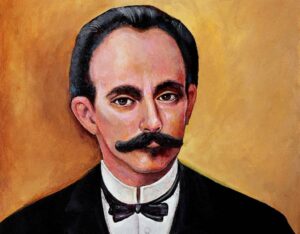
Jose Marti
Our group had dinner that night in the courtyard of Dona Eutimia, a paladar—one of the private restaurants that have opened since 2010, when the government, in an attempt to boost the feeble economy, began letting people start their own businesses. Many had turned their homes into paladars, which serve far better food than the state-run restaurants.
We ordered at 7 p.m. but did not receive our meal until 9, which is typical for the paladars. The cooks prepare everything in tiny home kitchens with primitive ovens. During the wait, we listened to live musicians and drank mojitos or shots of Habana Club Especial, a primo rum that sells for only $8 a bottle. When the meal arrived, it was worth the wait: wooden platters of paella with huge chunks of fresh-caught lobster, shrimp, chicken, saffron rice and fried plantains, followed by café cubano, delicate cups of sweet thick coffee. Most Cubans couldn’t afford a meal like this; they’re lucky to get an occasional chicken with their ration cards.
As we walked home, the streets were filled with families, lovers, and, as we left the old city, beggars, who are kept away from tourists but lurk on the streets nearby, pleading for shampoo and soap. Apparently toiletries made in Cuba are gluey and ineffective. We’d been told before the trip that if we wanted to give people gifts, we should bring items that are scarce on the island: pencils and pens, school supplies, guitar strings, reading glasses, and over-the-counter drugs like aspirin. The government warns tourists not to give to beggars, but they looked so abject it was hard to turn away.
On Sunday, a 28-year-old novelist, whom I’ll call Raffi, joins us for the day’s sightseeing. Wearing a straw hat with a black band, khaki pants, and sunglasses tucked in the V of his yellow polo shirt, Raffi has an open face and dark eyes quick to smile. He’s a friend of one of our leaders, Trish, who’s guided many trips to Cuba.
Raffi, two others and I climb into a taxi—a ’55 Chevy that’s been completely refurbished, with air conditioning, a rebuilt motor, new upholstery and paint, and stereo sound coming out of the ancient radio. The drivers use ingenuity and parts they scrounge on the black market to keep the cars in peak condition. Raffi tells me the driver makes more than surgeons, who earn about $25 a month. “I have friends with Ph.D.’s who drive taxis,” he says, explaining that there are two currencies in Cuba—CUC’s (called kooks), for tourists, and CUP’s, or pesos, for Cubans. The CUC is worth about a dollar but the peso is worth four cents. Taxi drivers and others who work with tourists get paid in CUC’s, but all other Cubans get the measly pesos, and they can’t live on pesos alone. Some earn cash from illegal activities and others get money sent from relatives abroad.
Raffi says his grandfather was a founder of the Cuban Communist party, but his grandmother hates the revolution. “She had a business that they nationalized and took away,” he says. “She thinks the revolution ruined the country.” His grandfather, who owned a small coffee shop, was so passionate for the revolution that when officials came to his shop, he said, “Take it!” Raffi smiles. “They were like cat and dog. That’s why they were so in love.”
We pass a billboard, “United for a sustainable socialism.” I ask Raffi why I haven’t seen or heard the word “communism.” He shrugs. “Today we don’t speak of communism. We want a socialism where the government controls the most essential parts of the economy but not all.” Raffi is working on a novel about Jose Marti, which, he says, “has helped me a lot. When you learn about the man, you fall in love with the country he lived and died for.”
“What do you think Marti would make of Cuba today?”
Raffi throws back his head and laughs. “That’s a question I ask myself every day.” He says Marti would have wanted the revolution and the good things it brought—free education and health care for everyone. “But…” He raises his hands, palms up.
I tell him I’ve read Havana Real, by the dissident blogger, Yoani Sanchez, who describes how she grew up hungry and obsessed with food, had to wait years to get a pair of eye glasses, and had her blog repeatedly shut down by “faceless censors.”
Raffi nods. “What’s revolutionary at one time can become orthodox tomorrow.” He believes this is what happened with the Cuban revolution—the idealistic cause became frozen into a defensive and rigid bureaucracy. “We have to revolutionize the revolution,” he says.
The same is true, I tell him, of the American revolution. What the founders conceived of as a system of checks and balances has devolved into obstruction and paralysis. “We need to revolutionize it.”
Raffi and I learn we share a love of “Cuban fusion music,” made by young musicians who merge traditional Cuban rhythms with other genres—rock ‘n roll, blues, reggae, African, and Brazilian. He tries to find a fusion concert that night, but most are not advertised openly but promoted by word of mouth. Not finding one, he takes me to a large club, the Casa de Musica Habana. There are two show times in Cuba: the matinee, from 5 to 9 p.m., and the night show, from 11 p.m. to 3 a.m. We arrive during the interval when the place is closed, so we wait on a nearby park bench. Raffi lives in this neighborhood, with his grandmother, a cousin, her husband and their baby.
This is central Havana—drab, crowded, and ugly—where a building collapses every three days. The buses are so full that people have to fight their way inside, so they often walk the distance or splurge on a bicycle taxi. Raffi says, “People think this is because of the embargo, but Cubans are also responsible. If we can build fancy hotels and a new super highway for tourists to get to Varadero beach, we could build homes for Cubans.”
Raffi spots a cluster of 10-year-old girls who live on his block, sitting on a bench across from us, singing in harmony. Raffi waves and calls, “How come you don’t say hello?” The girls jump to their feet and run over, forming a line in front of Raffi. As if moving down a reception line, each girl takes Raffi’s hand and touches her left cheek to his, then her right cheek to his, then takes my hand and does the same. It’s the sweet Cuban greeting—touching both cheeks—that I’ll come to savor.
After the girls run back to their bench, Raffi tells me he’s different from most of his peers, because his mother was a diplomat who took him with her to other countries. “I’ve seen the world, but others my age want to see what’s outside Cuba.” Most of his friends, including his girlfriend, say, “There’s no future for us in Cuba.” They study at university, complete graduate work, but then find there are no openings for the jobs they’ve been trained to do. His best friend studied computer science and can’t get hired in that field.
None of his friends are married, and if they were, they wouldn’t be able to find housing and would have to crowd in with relatives. Most of them want to leave, but not Raffi. “I’m happy in Cuba,” he says. “The country is changing, but people don’t believe it yet. They self censor, holding back their real thoughts out of fear.”
When the club opens, they charge me 10 CUC’s and him 3 pesos to go inside, where the music is reggaeton, not my favorite or his, and it’s loud. Eardrum-busting loud. I watch young women grind and shake, rubbing their boobs in men’s faces or grabbing hold of a guy’s buttocks and slamming their crotch into it.
We leave after twenty minutes and I’m disoriented. In the early days of Women’s Liberation, I was part of the cohort who stopped shaving our legs and were annoyed when guys whistled at us on the street. We insisted on being seen not as sex objects but as full and fully valued human beings. What’s with the Cuban women?
There are two questions I start asking everyone I meet: “Why are the women so flamboyant in flaunting their bodies?” And, “Can the Cuban government change its spots?”
When I tell our tour guide, Liliana, about the women I saw at the Casa de Musica, she shakes her head. “Those were jinateras, girls who sell themselves to make extra money.”
“But most of the women around here dress like that. Why?”
“Ask the men,” she says, turning to a group of locals drinking coffee at the next table. They give several reasons: “the climate,” “it’s the style,” and “the men like it.” Laughing, one adds, “We don’t have dangerous animals in Cuba. Only women.”
Liliana says the two major forms of entertainment are music and sex. At most clubs they have condoms on the menu, and sex education starts early. “They use a banana,” she says.
As to whether Cuba’s government is changing, I hear two narratives: “It’s changing fast,” and “It will never change.”
In old Havana, Julio Larramendi, a chicly dressed photograher and gallery owner, says, “With Raul at the helm, things will be different. Cuba today is not what it was two years ago—we’re allowed to travel, buy and sell property, and express our opinions. And next year there will be greater changes.”
I hear the opposite on the plane we take from Havana to the Eastern city of Holguin, when I ask a 26-year-old chef, Juan, if the government is changing. He gives his head a firm shake. “Maybe when I die. My father is 56 and all my life, he’s been saying things will change, some day it will be different.”
Juan, who wears a gold earring and his hair cut and gelled to stick straight up, had to pay a fee to be admitted to culinary school, where he studied four years to get a job in a restaurant that pays him $15 a month. He would like to visit relatives in New Jersey, but to apply for a visa, he says, “You have to go to Havana two times, buying two round-trip tickets, and pay $160, whether you get the visa or not. That adds up to a whole year’s salary.” He frowns. “Nothing’s changed.”
End of Part One and Two. Watch for Part Three.
Sara, Thanks very much for that share. I would add, from a trip that I made to Cuba about. the same time, also, that the one requirement was that our small(ish) group had two (minimum) cultural contacts with the Cuban people daily. That really enriched our trip!
I went through a spell of sudden-onset dizziness in 2016, and when I had a spell I literally couldn’t do anything until it went away. I was stuck wherever I was at that moment. I once spent an hour parked along the curb in an innocuous neighborhood hoping no one would call the police about the strange man in front of their house who couldn’t have walked a straight line to save his grandmother. Then it was gone and I hadn’t had any spins for over a week and Bouchercon was in NOLA and I was already signed up. I was able to change my ticket but ended up going from the Springs to LAX to Houston Hobby to NOLA. But I got there. I was on a panel at 3 pm Thursday. It went fine, but as I was leaving the room, it started to spin. I literally had to claw the walls all the way back to my room. From Thursday afternoon until Sunday morning I didn’t leave the bed except for when I slid along the floor to the bathroom. One of my favorite places on earth and I was grabbing the sheets to keep from falling onto the floor for two and a half days while trying to convince myself that a building the size of the NOLA Marriott really couldn’t spin, clear evidence to the contrary notwithstanding. A couple of weeks earlier, my condition had been diagnosed as neuronitis, an inflammation of the area of the brain that controls balance. What can be done? The doctor said, “Nothing. It will eventually go away on its own. Probably.” Never in a million millennia would it have occurred to me that going to Cuba was an antidote for the spins.
I’ve never been to Cuba and it’s probably too late now, but I would have gone just to see the cars. And women, since I would be there anyway. I have spent time in “Little Havana” in Miami where the women dress pretty much the same as in Cuba, law enforcement officers excepted. Decades ago, I was there with my ex-wife who felt compelled to comment that all the women were dressed like sluts. I told her she had it backward, “It’s the sluts who dress like Cuban women. Besides, what’s wrong with sluts. I like sluts.” Which was the end of that evening’s conversation.
thanks, David. Your last line made me laugh. Warmest, Sara
PS it’s never too late to go to Cuba.
Hi Sara, your visit to Cuba brought back memories of our trip much earlier in 2000. My wife and I and a travel agent friend went the illegal route, flying to Toronto, as a tourist overnighting there, then boarding a flight to Havana. Cuban authorities were smart, did not stamp our passports. I took lots of photos and my wife Lorraine Diehl, a freelancer wrote a piece for the NY Daily News. Unlike your stay except for a side trip to see Hemingway’s Finca Vigia we toured Havana. In her article Lorraine wrote “Cuba is in a time warp Jt’s fragile embargoed economy has turned Havana’s narrow streets and wide boulevards into a moving museum of 1950’s brightly colored American cars. But don’t let appearances fool you. Even if time has passed her by this lady still has her charm and there is a sense that time has stood still.” We stayed at the Hotel Nacional. We had several dinners at paladars (private homes turned into mini restaurants) the Cubans we met were friendly and curious. Sara it was a trip we’ll never forget and yes absence that time had stood still. Fabulous mojitos and music that took me back to the “Babalu” days of Desi Arnaz and Lucy. Thanks for your memories Sara, best wishes Bill who spent the late 60’s and early 70’s at WNEW then a 50 year career at the ABC radio network. Best wishes. Text if you like 917-225-2462 Bill
This is fascinating on many counts, really enjoyed reading it, and learned a lot about Cuba as well.
Loved it, Sara. Cedar and I spent a wonderful week in Old Havana in early 2019. xxoo, Ren
I loved reading this. So glad you reposted. I don’t know anyone who has traveled to Cuba. What wonderful memories for you.
Look forward to part two of trip to Cuba
I am waiting impatiently for the next installment. Only rich people from the USA go to Cuba and they seem to think it quaint I think of it as a prison. You can’t leave, can you? I want to learn more about it from your perspective.
Hoping to see part 2 your Cuba visitb
Although the people, music and scenery were wonderful, I became an anti communist during my one week, university sponsored trip to Havana and the Bay of Pigs. Avi Chomsky of the Chomsky dynasty led the trip which included SSU professors like my husband and impressionable students, many recent immigrants who were learning to despise the USA and laud the Communist system in spite of the poverty and decay that we saw with our own eyes.
One member of the tour was expelled and he and his nursing professor companion managed to continue on their own despite the currency problems (no credit cards accepted). I myself was pulled away from a conversation with Computer Science students at the University of Havana, so my eyes were suddenly wide open! What would happen to real dissidents? No newspapers or access to tv as I had had access to on my other trips to communist countries I had visited. Instead a steady stream of propaganda filled lectures (Did you know that Castro loved Kennedy?).
Much as I dislike Trump and his MAGA party, I did see that even young immigrants from El Salvador were learning to disdain the U.S.! This was at the beginning of Trump’s first campaign but other tour groups reacted, again with disdain, at the very mention of Democracy (“How is that working out?” ) instead of alarm!
So when Trump pronounced that the universities had become anti American and later antiIsrael even on October 8, I understood that he had a point!
I loved Cuba and would recommend a visit but many of those sexily dressed women are making much needed money escorting foreign tourists with the tacit blessing of the Cuban govt.!
See for yourself what many “genius” professors and students see as a viable alternative to democratic capitalism!
i was your real estate agent in the Venice/Marina back in the 70’s. Basking in the LOOSE CHANGE aftermath. Good memories. What you didn’t know was that I had spend a great deal of time in Cuba pre and after Castro. I find your present day observations most interesting as a contrast to the late 50’s.
Hello Hank! Good to hear from you. I hadn’t known you’d been to Cuba, and when almost no one I knew had been there. Warm wishes to you. Sara
There was a great deal of spook stuff going on there during the 1958-1962 years.Great flashbacks of being a witness to history.I have some very close Cuban friends with whom memories are shared of the good old days. Best always to you. Hank
You led everyone in the limbo! That’s fabulous and everything else you’ve written here is fascinating.
Just loved these reflections, Sara. Cedar and I had a wonderful week in Cuba at the beginning of 2019 & in early October ’25 will be visiting a young Cuban couple we befriended who now live in Valencia, Spain.
Oh Sara, these Cuba posts are marvelous–they made me put Cuba back on my Bucket List. Thank you!!
Wonderful, enlivening experiences. Good for you